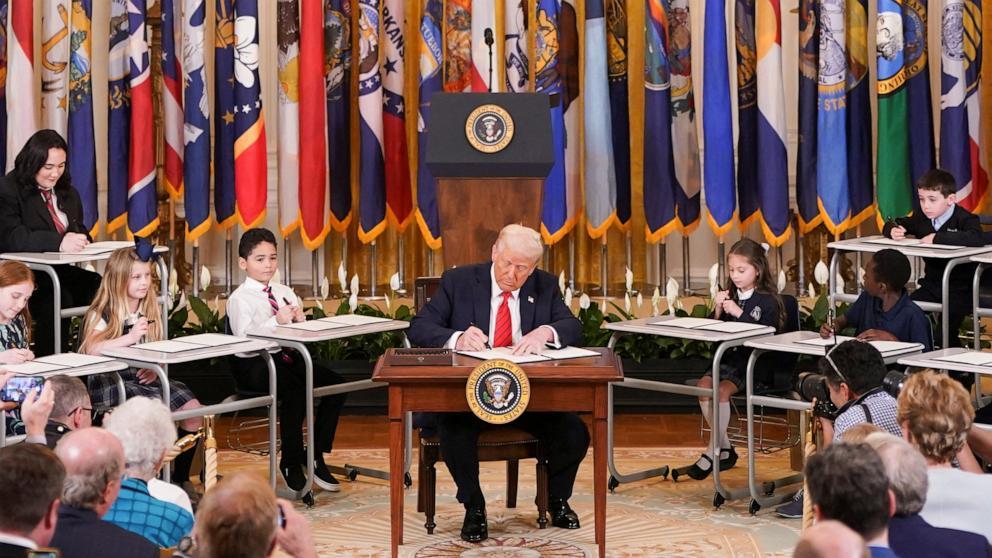
In a move that has sparked widespread debate and concern across the United States, former President Donald Trump has initiated sweeping efforts to dismantle the Department of Education. This unprecedented push challenges decades of federal oversight in American education, raising critical questions about the future of public schooling, student protections, and educational equity. As the ramifications of these policies begin to unfold, this article explores the motivations behind Trump’s actions, the impact on the nation’s educational landscape, and what lies ahead in this contentious policy battle.
Trump’s Vision for Education Federalism and Its Implications
Under the Trump administration, education policy underwent a radical shift towards decentralization, aiming to reassert state and local control over schooling decisions. This vision champions a minimalist federal role, contending that education is best managed closer to the communities it serves. Central to this approach was the rollback of federal mandates and regulations, viewed as overreach stifling innovation at local levels. Key initiatives included promoting school choice, expanding charter schools, and reducing federal oversight on curriculum standards.
Implications of this federalism strategy extend beyond governance. By funneling responsibility downward, disparities in education quality are poised to widen, as resource allocation and policy priorities will now vary significantly between states. Critics argue this could exacerbate inequities for disadvantaged students, while proponents celebrate the increased flexibility and empowerment for educators and parents. The administration’s stance also recalibrated federal funding formulas, emphasizing block grants and local discretion rather than prescriptive spending.
- Increased autonomy for state education departments
- Reduced federal intervention in curriculum and testing
- Support for privatization and school voucher programs
- Potential risks to nationwide equity standards
| Policy Area | Federal Role Under Trump | Potential Impact |
|---|---|---|
| Funding | Block grants, local control | Varied resource distribution |
| Testing & Accountability | Reduced federal mandates | Diverse standards, inconsistent benchmarks |
| Curriculum | Minimized federal involvement | Greater local adaptability, risk of fragmentation |
Budget Cuts and Policy Changes Impacting Public Schools
Recent policy shifts under the Trump administration have led to significant budget reductions for public schools nationwide, sparking concern among educators and parents alike. Funding that traditionally supported critical programs—such as special education, after-school activities, and teacher training—has been either slashed or rerouted to favor school choice initiatives. These changes threaten to widen educational disparities, particularly in underserved communities where resources are already scarce. Analysts warn that the consolidation of power away from the Department of Education may undermine federal oversight, leaving local districts to grapple with financial instability and inconsistent policy enforcement.
Key impacts of these budget and policy changes include:
- Reduction in Title I funding for low-income schools
- Scaling back of enforcement on civil rights protections
- Decreased support for public school infrastructure improvements
- Expanded promotion of charter and private school vouchers
| Fiscal Year | Budget Change | Program Affected |
|---|---|---|
| 2017 | −10% | Title I Grants |
| 2018 | −15% | Special Education |
| 2019 | −20% | After-school Programs |
Reactions from Educators, Parents, and Lawmakers
Educators have voiced deep concerns over the potential impacts on public schooling, fearing that the dismantling could lead to reduced federal oversight and funding, disproportionately affecting under-resourced districts. Many teachers and school administrators argue that without a centralized Department of Education, national standards and accountability measures would weaken, resulting in a fragmented and inequitable education system.
Parents and lawmakers remain sharply divided. While some conservative lawmakers applaud the move as a step toward state autonomy and local control, several parent groups and Democratic legislators condemned it as a threat to educational equity and safety nets for vulnerable students. Below is a snapshot of key stakeholder sentiment:
| Group | Primary Concern | Representative Quote |
|---|---|---|
| Educators | Loss of federal support and standards | “This move risks creating chaos in already struggling districts.” |
| Parents | Equity and safety for children | “We need a strong program to protect all students’ rights.” |
| Lawmaker (Conservative) | State-level control | “Local governments should decide what’s best for their schools.” |
| Lawmaker (Democrat) | Protecting federal education initiatives | “Dismantling is a dangerous step backward for our future.” |
Forecasting the Future of Education under a Reduced Federal Role
The anticipated retreat of the federal government from educational governance is poised to reshape the national landscape in unprecedented ways. States and local districts may gain autonomy but will also encounter heightened disparities as they assume greater responsibility for funding, policy-setting, and accountability measures. This devolution could lead to a patchwork of educational quality, with some regions pioneering innovative programs that better cater to local needs, while others, constrained by limited budgets, struggle to maintain basic standards.
Key implications of diminished federal oversight include:
- Increased funding variability: State budgets will determine resource allocation, creating an uneven financial landscape across districts.
- Curriculum divergence: Local control may foster experimentation but risks inconsistency in educational outcomes nationwide.
- Reduced enforcement of civil rights protections: Federal withdrawal could weaken mechanisms designed to ensure equity for marginalized groups.
| Aspect | Potential Outcome |
|---|---|
| Standardized Testing | Fragmentation; state-specific assessments replace national benchmarks |
| Special Education | Varied compliance levels; possible reduction in services |
| Teacher Certification | Diverse requirements; mobility challenges between states |
Closing Remarks
As the Trump administration continues to reshape the federal landscape, its moves to dismantle the Department of Education signal a significant shift in the nation’s approach to public schooling and federal oversight. Critics warn that this could lead to reduced support for vulnerable student populations and greater inequality in education access. Supporters, however, argue it paves the way for increased local control and school choice. What comes next remains uncertain, but the implications for American education policy—and millions of students—will be closely watched in the months ahead.